
The Psychology of Money Chapter 10: Save Money

Updated: May 7
In 1989 a Ford Taurus, which is a sedan, got 18.0 miles per gallon. In 2019 when Housel was writing, a Chevy Suburban, which is a much larger SUV, got 18.1 MPG. Today, you can get fully electric trucks. In the 70s, there were projections that the world would run out of oil before 2025, where we are today. While there’s still a lot of conversations around oil use and production, we haven’t run out like the projections once estimated. Part of the reason is that we’ve found more, but largely this is due to increased efficiencies, like the ability to drive a Suburban with the same gas as a Taurus used to need.
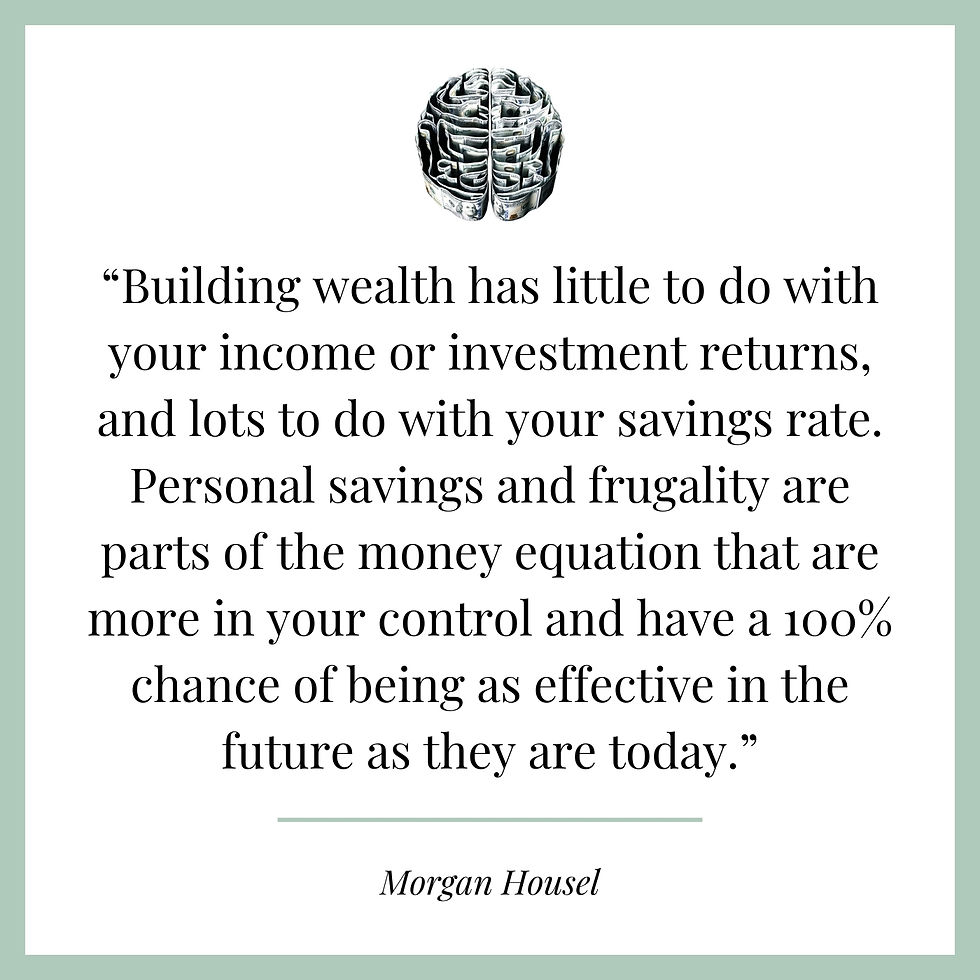
Housel draws this analogy to our finances. Our supply of money (income) can be negatively affected by factors out of our control: bear markets that decrease portfolio income, legislation changes that decrease Social Security benefits, getting laid off, disability or death (leaving dependents to deal with the financial implications). But much like the work in creating more fuel-efficient vehicles, we can do the (often hard) work of becoming more financially efficient i.e. spending less, saving more.
Considering the drastic living situations many in developing countries endure, it’s not hard to see that everything from the housing to the food to the amenities we all pay for can be reduced. This is not to say that they need to, in fact we often work with clients on how to spend, enjoy, and use more of their money that they otherwise feel comfortable to. Housel’s point is simply that “learning to be happy with less money creates a gap between what you have and what you want.” Managing this gap, the desire to have something that you could legally and logistically obtain (by spending all your money, not saving for retirement, going into debt, etc.), is the behavioral side of finance, and why our success is largely controlled by how we behave.
When we spend less and save more, we increase our savings rate. This is a key concept, and is simply the amount of money we save divided by the money we make. For example, if we take home $100,000, and in all (bank, work retirement accounts, IRAs, etc.) we save $10,000 throughout the year, our savings rate is 10%. This means we’re used to spending the other $90,000. In one year, we have $10,000 saved, which is 11.11% of the $90,000 (10÷90) we would likely like to continue to spend should something happen to our income (disability, retirement, etc.). But watch what happens when we increase from 10% to 15%. We take home the same $100,000, but now we’re saving $15,000. The magic is that this means we’re now used to spending only $85,000, so now our $15,000 saved is 17.65% of our desired annual income (15÷85). Every dollar we save is another dollar we have for later. That much is obvious (hopefully). But what’s not so obvious is that we’re spending one dollar less and that dollar, as it compounds (see chapter 4), continues to afford a much greater percentage of our income should the need or desire arise to replace it.
Success in our personal finances comes down to how we behave. One behavior we can practice:
Save money!
If you’d like to engage further, I’d love know
If you are retired, how does or did it feel once you were no longer saving but instead started spending the funds you spent so long accumulating?
If you are not retired, what is your savings rate?
To calculate, find out: what is your after-tax takehome pay? What is the amount you’re saving into any vehicle (bank, retirement accounts, etc.)? Are you spending any more than your take home pay by taking on extra debt? Then divide how much you save by your net income (including from debt).
Until next time, happy reading!
